

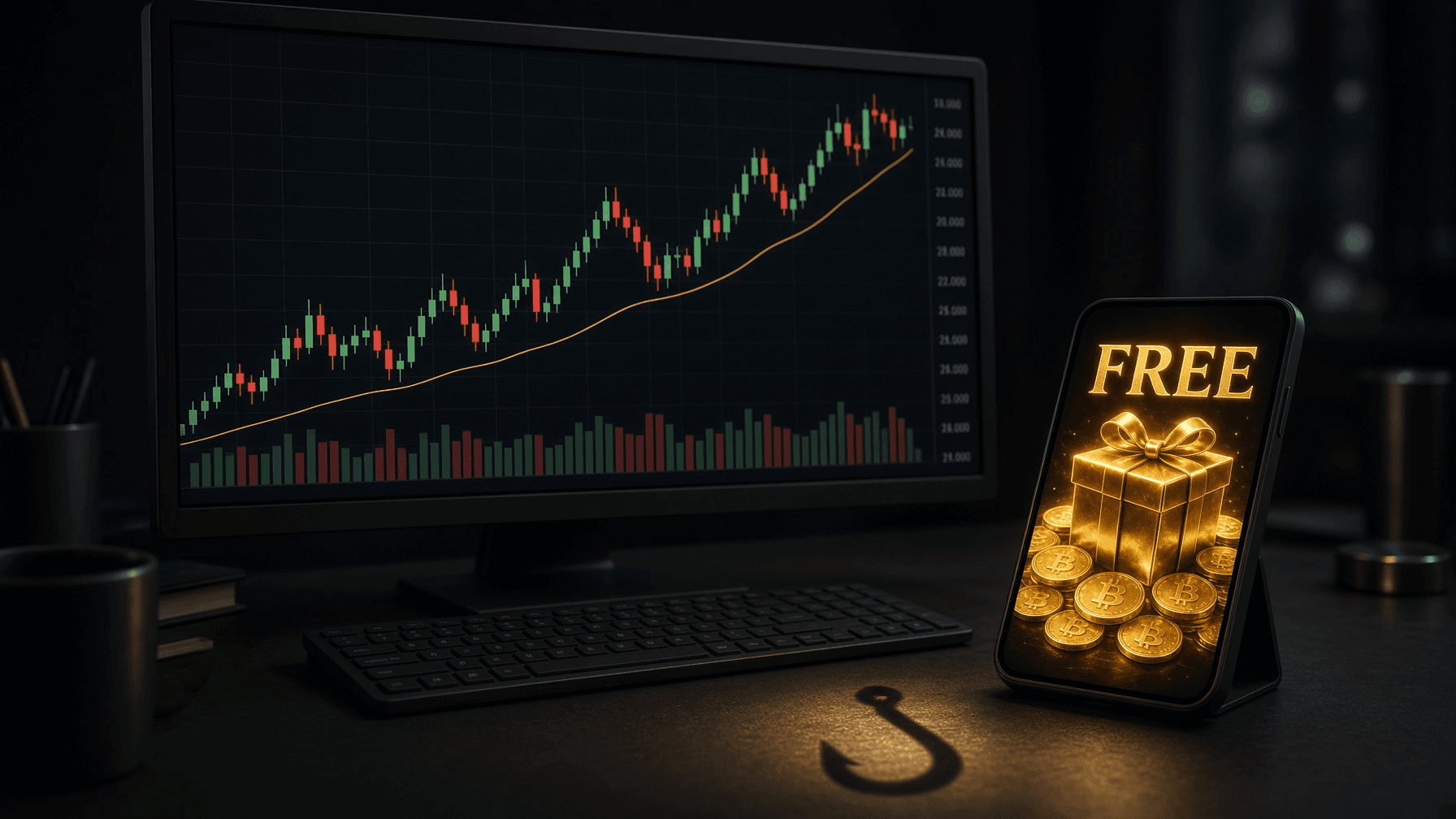
Comment obtenir des cryptos gratuites en 2026
Toutes les vraies façons d'obtenir des cryptos gratuites en 2026, avec des chiffres honnêtes : ce que paient vraiment les bonus d'inscription, pourquoi les offres à « 1 000 $ gratuits » sont un appât, et où vos heures rapportent plus.
Vous avez cherché « comment obtenir des cryptos gratuites ». Voici la réponse honnête, d'entrée de jeu : la crypto gratuite existe, elle plafonne autour de 55 $, et chaque dollar a une raison d'être. Personne ne donne de l'argent. Jamais. Certaines entreprises vous paient — parce que vous faites quelque chose qui mérite d'être payé.
Cette distinction, c'est tout l'article. Une fois que vous la voyez, vous repérez n'importe quelle arnaque en dix secondes et vous encaissez toutes les vraies offres sans perdre une seule heure.
Voici le menu complet, avec les chiffres que personne ne met dans le titre :
| Méthode | Valeur réaliste | Ce que vous leur donnez vraiment |
|---|---|---|
| Bonus d'inscription des exchanges | 5–55 $ | Un client vérifié, approvisionné et actif |
| Programmes learn-and-earn | 1–10 $, une fois | Votre attention, et un contact |
| Airdrops | Généralement 0 $, parfois de l'argent réel | Des mois d'usage précoce et d'activité on-chain |
| Faucets et apps de récompenses | 0,25–0,65 $ de l'heure | Votre temps, des vues publicitaires et vos données |
| « Envoyez des cryptos, recevez le double » | Moins tout ce que vous envoyez | Votre argent. C'est ça, le produit. |
La seule règle qui explique tout
La crypto gratuite est un budget marketing. C'est tout. C'est ça, le secret.
Un exchange paie 55 $ pour un nouvel utilisateur comme une banque paie 300 $ pour un nouveau compte courant : un client vérifié, approvisionné et actif vaut plus que ça sur la durée. Un programme learn-and-earn vous paie 3 $ en tokens parce que le projet a acheté votre attention. Un airdrop paie les premiers utilisateurs parce qu'il faut des gens pour éprouver le produit avant le lancement.
Dans chaque cas réel, vous pouvez pointer du doigt ce que l'autre partie y gagne. Dès que vous ne pouvez plus — quand quelqu'un vous offre de l'argent pour littéralement rien — vous n'êtes plus le client. Vous êtes la cible.
C'est pourquoi la recherche que vous venez de faire est l'une des plus dangereuses de la crypto. Le FBI a compté 11,4 milliards de dollars perdus par les Américains dans des arnaques crypto rien qu'en 2025 — en hausse de 22 % sur un an, plus de la moitié de toutes les pertes déclarées liées à la cybercriminalité, avec une moyenne d'environ 62 000 $ par victime. Une part énorme a commencé exactement ici : quelqu'un cherchait de l'argent gratuit, et a trouvé quelqu'un qui faisait semblant d'en distribuer.
Ce qui paie vraiment (avec des chiffres honnêtes)
Bonus d'inscription des exchanges : 5–55 $
C'est la meilleure « crypto gratuite » qui existe, et elle est réelle pour une raison simple : l'acquisition d'utilisateurs est le premier poste de dépense d'un exchange, et vous payer vous coûte moins cher que payer Google.
Le deal est explicite. Vous vérifiez votre identité, vous déposez généralement quelque chose, parfois vous passez un ordre — exactement ce qui fait de vous un vrai client — et l'exchange vous crédite un bonus. Nous en avons un nous-mêmes : Gate.io paie 55 $ en USDT pour KYC + dépôt + un ordre, et c'est retirable, pas des points.
KYC + dépôt + un ordre · USDT réels et retirables · Indisponible pour les résidents américains
Maintenant, les petites lignes sur le reste du marché, parce que c'est là que vit l'appât :
- Les vrais bonus sans dépôt vont de 5 à 50 $. C'est le tarif du marché pour une inscription vérifiée, dans toute l'industrie.
- Les titres « 1 000 $ gratuits » ne sont ni 1 000 $ ni gratuits. Ce sont presque toujours des crédits de frais non retirables ou des bons d'essai futures, débloqués par paliers selon le dépôt et le volume tradé. Le montant complet du titre exige généralement des dépôts et des volumes que la plupart des gens n'atteindront jamais.
- Lisez une seule ligne avant de vous inscrire : le bonus est-il retirable, et qu'est-ce qui le débloque ? Si la réponse tient en trois paragraphes de paliers, le chiffre du titre n'est pas pour vous.
Pour la vue d'ensemble, nous avons comparé les principaux exchanges et leurs bonus dans notre guide des exchanges.
Learn-and-earn : quelques dollars, une fois
Les programmes façon Coinbase vous paient de petites sommes en tokens pour regarder de courtes leçons et réussir des quiz. C'est réel, c'est sûr et c'est peu — de quelques centimes à quelques dollars par cours, souvent avec des plafonds par utilisateur et des restrictions par pays. Ça vaut le coup si vous apprenez de toute façon. Ça ne vaut pas le coup de faire semblant que c'est un revenu.
Airdrops : l'argent réel existe, mais c'est du travail — et un champ de mines
Les airdrops sont la seule catégorie où « gratuit » a parfois voulu dire quatre chiffres : des protocoles distribuant des tokens à ceux qui utilisaient le produit tôt. Ces histoires sont vraies. Voici ce qu'elles omettent :
- Ceux qui ont été payés étaient des utilisateurs actifs et précoces pendant des mois — bridges, trades, tests. C'est du travail non rémunéré qui, la plupart du temps, ne paie rien.
- Pour chaque vrai airdrop, il existe des dizaines de faux sites de « claim » construits pour vider le wallet que vous connectez. Le lien de claim qui circule sur X et Telegram a plus de chances d'être le drainer que l'original.
- Un vrai airdrop ne demande jamais d'envoyer des cryptos d'abord, de payer des « frais de déblocage » ou de saisir votre phrase de récupération. Pas une fois, jamais.
Si un token que vous n'avez jamais demandé apparaît dans votre wallet : n'y touchez pas. Interagir avec est souvent le piège lui-même.
Faucets et apps de récompenses : mathématiquement, ça ne vaut pas le coup
Les faucets et les apps « gagnez des cryptos » paient des fractions de centime par clic, captcha ou sondage. Mesuré honnêtement : les utilisateurs assidus qui y passent 2 à 3 heures par jour sur plusieurs plateformes dégagent 15 à 40 $ par mois — environ 0,25 à 0,65 $ de l'heure, sans compter les sondages qui vous éliminent à mi-parcours. Il n'y a pas d'arnaque ici. Juste un salaire si bas qu'il prouve la thèse de cet article mieux que tout : personne ne distribue de l'argent réel.
Ce qui ne paie jamais
Chaque faux plan « crypto gratuite » est l'un de ces quatre costumes sur le même corps :
- Le doubleur / giveaway. « Envoyez 1 BTC à cette adresse, recevez-en 2 en retour. » Des lives avec le visage d'une célébrité, des comptes à rebours, de faux flux de paiements. Posez-vous la seule question qui compte : pourquoi quelqu'un qui possède une machine à doubler l'argent aurait-il besoin de vos coins ? Les cryptos envoyées sont perdues — il n'existe pas de rétrofacturation.
- Le faux site de claim d'airdrop. Une copie au pixel près de la page d'un vrai projet, qui vous demande de connecter votre wallet et de signer une transaction pour « réclamer ». Cette signature est l'approbation d'un drainer.
- Le « cloud mining gratuit » à profit quotidien garanti. Les revenus réels du minage fluctuent avec la difficulté, le prix et l'électricité — ils ne peuvent pas promettre « 2 % par jour ». Un tableau de bord léché avec un solde qui grimpe, de petits retraits honorés au début pour gagner votre confiance, puis le gel quand du vrai argent est à l'intérieur : c'est le cycle de vie d'une pyramide, et c'est l'arnaque au minage la plus répandue à l'entrée de 2026.
- Tout ce qui veut votre phrase de récupération. Agent du support, « vérification », bot de giveaway — peu importe. La phrase est le wallet. Celui qui l'a, le possède.
Un seul signe couvre les quatre : on vous demande de donner un accès ou de l'argent avant d'avoir reçu quoi que ce soit. La vraie crypto gratuite ne fonctionne jamais dans ce sens.
Le meilleur deal pour les mêmes heures
Faites le compte. Toute la crypto gratuite réellement disponible pour une personne en 2026 — un bon bonus d'inscription et quelques cours learn-and-earn — représente 60 à 100 $, une fois. Les circuits de grind paient moins d'un dollar de l'heure. Et cette recherche voisine avec une industrie qui a pris 11,4 milliards de dollars aux gens l'an dernier.
Pendant ce temps, ce qui se capitalise vraiment, c'est ce que personne ne tape dans Google : savoir ce que vous faites. Trois heures par jour sur des faucets, c'est 30 $ par mois, pour toujours. Trois heures par jour à apprendre comment bougent les marchés — lire l'action des prix, comprendre quand le sentiment bascule, observer comment les vrais signaux se déroulent — construisent une compétence qui grandit avec chaque dollar que vous y mettrez un jour.
Pas besoin d'argent pour commencer. L'offre gratuite de Flicker vous donne des signaux de trading en direct sur les cryptos, les actions et le forex, des alertes de prix sur les actifs que vous suivez, et l'indice Fear & Greed pour voir ce que ressent la foule — sans dépôt, sans carte.
👉 Oubliez les faucets. Apprenez à lire le marché — gratuitement →
FAQ
Existe-t-il de la crypto vraiment gratuite, sans aucun dépôt ?
Oui : les bonus au KYC seul (généralement 5–15 $) et les récompenses learn-and-earn. C'est le plafond honnête sans dépôt. Tout ce qui est au-dessus exige de déposer, de trader ou de travailler.
Les airdrops valent-ils encore le coup en 2026 ?
Comme un ticket de loterie payé en temps, parfois. Comme un plan, non. Ceux qui ont payé récompensaient des mois d'usage précoce authentique, et la catégorie est saturée d'arnaques au drainer. Ne payez jamais pour réclamer, ne signez jamais une transaction que vous ne comprenez pas, ne partagez jamais votre phrase de récupération.
Comment repérer un faux giveaway en dix secondes ?
On vous demande d'envoyer des cryptos d'abord, de connecter un wallet et de signer pour « réclamer », ou de fournir votre phrase de récupération. N'importe lequel de ces points signifie faux — 100 % du temps, sans exception, quel que soit le visage affiché.
La crypto gratuite est-elle imposable ?
Dans beaucoup de pays, oui : les bonus d'inscription, les récompenses learn-and-earn et les airdrops peuvent compter comme un revenu à la réception. Les règles varient selon la juridiction — vérifiez les vôtres avant de considérer un bonus comme de l'argent invisible.
Quel est le meilleur coup « crypto gratuite » en ce moment ?
Un bon bonus d'exchange — il paie plus qu'une année de faucets pour une demi-heure d'étapes que vous feriez de toute façon. L'offre de 55 $ de Gate.io est la plus solide que nous connaissions qui paie réellement.
Ceci n'est pas un conseil financier
La crypto comporte des risques, et la crypto « gratuite » comporte ceux décrits ci-dessus. Les conditions, la disponibilité et les montants des bonus changent et varient selon les régions — Gate.io ne sert pas les résidents américains. Vérifiez chaque offre sur le site officiel de l'exchange avant de vous inscrire, et ne partagez jamais votre phrase de récupération. Cet article est fourni à titre informatif uniquement et ne constitue pas un conseil en investissement.
- crypto gratuite
- bonus d'inscription
- airdrops
- arnaques crypto
- faucets
- débutants
À lire aussi
Meilleures applications de signaux de trading crypto, actions et forex en 2026 (7 testées)
La plupart des applications de signaux ne couvrent qu'un seul marché. Si vous détenez du Bitcoin, quelques actions et surveillez l'EUR/USD, vous jonglez avec trois applications. Voici les 7 meilleures applications multi-actifs sur mobile — et quelles classes d'actifs bénéficient réellement de signaux.
Signaux de Breakout sur les Altcoins : Comment Capter le Momentum Avant la Foule
Taux de financement, pics de volume et indicateurs techniques — les trois signaux qui apparaissent avant le breakout d'un altcoin, pas après. Voici comment les lire ensemble et repérer les mouvements de momentum avant tout le monde.
Quelle appli envoie les meilleures alertes de trading crypto ? 7 comparées pour 2026
La plupart des applis d'alertes vous font deviner le prix. Les meilleures vous donnent le niveau. Voici une comparaison honnête des meilleures applis d'alertes crypto en 2026 — vitesse, types d'alertes, canaux, et ce qui est vraiment gratuit.