

How Can AI Help Improve My Cryptocurrency Investment Strategy in 2026?
AI isn't just hype anymore. Here's how machine learning is changing crypto trading — from smart money detection to automated zone analysis — and how to use it.
Everyone's talking about AI in trading. Most of it is marketing fluff.
But there are real applications — tools that analyze markets faster than humans can, detect patterns we'd miss, and quantify risk in ways that actually help you make better decisions.
Here's what AI can actually do for your crypto trading, what's still hype, and how to use these tools effectively.
What AI Actually Does in Crypto Trading
Let's cut through the buzzwords.
AI in trading means machine learning models trained on historical price data, volume patterns, and market behavior to:
- Identify patterns — Recognize chart formations, breakout setups, and trend structures
- Analyze sentiment — Process market mood from price action and momentum
- Detect smart money — Track institutional accumulation and distribution
- Generate predictions — Calculate probabilities for price movements
- Optimize entries/exits — Find optimal zones for trading
It's not magic. It's pattern recognition at scale — analyzing thousands of data points simultaneously across multiple timeframes.
7 Ways AI Improves Your Crypto Strategy
1. Trading Zone Detection
The problem: Finding good entry and exit points takes hours of chart analysis. Most traders draw zones subjectively.
How AI helps:
AI analyzes price history, volume profiles, and key levels to identify optimal trading zones automatically:
- Buy zones — Where probability favors long positions
- Sell zones — Where probability favors short positions
- Accumulation zones — Where smart money is buying
- Distribution zones — Where smart money is selling
Each zone includes entry range, stop loss, and multiple take profit targets — calculated from historical data, not gut feeling.
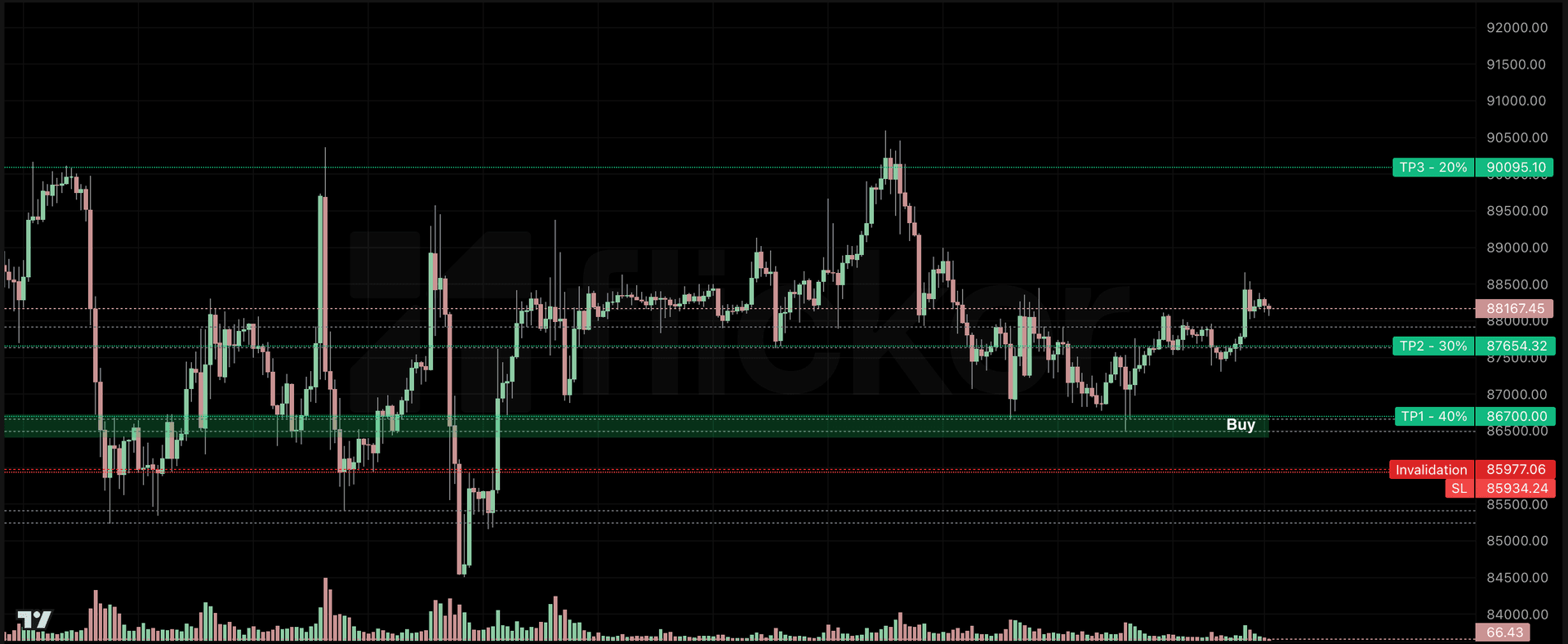
What you get: Complete trade setups with defined risk/reward ratios. No more guessing where to place stops or targets.
2. Breakout Probability Analysis
The problem: Breakouts look obvious in hindsight. In real-time, it's hard to tell which ones are real vs. false breakouts.
How AI helps:
Machine learning models analyze breakout setups and calculate:
- Breakout probability — Likelihood the move is real (0-100%)
- False breakout risk — Chance it's a fakeout
- Direction bias — Bullish, bearish, or neutral lean
- Pattern type — Triangle, channel, range, flag, wedge, compression
- Time horizon — Immediate, short, medium, or long-term
- Component scores — Individual ratings for structure, momentum, volume, volatility, trend alignment
Instead of "I think it might break out," you get "72% breakout probability with 18% false breakout risk."
What you get: Data-driven decision making. Take high-probability setups, skip low-probability ones.
3. Smart Money Flow Detection
The problem: Retail traders often buy when institutions are selling, and sell when institutions are buying.
How AI helps:
AI tracks volume patterns and price behavior to detect institutional activity:
| Smart Money State | What It Means |
|---|---|
| Accumulation | Institutions quietly buying — bullish signal |
| Distribution | Institutions quietly selling — bearish signal |
| Neutral | No clear institutional activity |
| Divergent | Price and smart money disagree — warning sign |
When you see "Distribution" while price is going up, that's a red flag. Smart money is selling into the rally.
What you get: Alignment with institutional traders, not against them.
4. Market Cycle Identification
The problem: Every market goes through cycles. Knowing where you are in the cycle changes everything about your strategy.
How AI helps:
Machine learning identifies four market phases:
- Accumulation — Smart money buying after a downtrend (best time to buy)
- Markup — Price appreciation phase (ride the trend)
- Distribution — Smart money selling at tops (time to take profits)
- Markdown — Price depreciation phase (stay out or short)
AI also calculates:
- Cycle transition probability — Likelihood of phase change
- Cycle stability — Confidence in current phase assessment
- Mean reversion probability — Chance price returns to average
What you get: Strategic positioning based on market phase, not random trades.
5. Multi-Timeframe Analysis
The problem: A setup might look great on the 1-hour chart but terrible on the daily. Checking multiple timeframes is time-consuming.
How AI helps:
AI analyzes your setup across all timeframes simultaneously:
- 3 minute to monthly charts
- Trend alignment across timeframes
- Momentum correlation
- Volume confirmation at each level
If 4-hour, daily, and weekly trends all agree, that's a stronger signal than a single timeframe setup.
What you get: Confluence confirmation without manually checking 8 different charts.
6. Risk Quantification
The problem: "This trade feels risky" isn't a risk management strategy.
How AI helps:
AI quantifies risk across multiple dimensions:
- Overall risk score (0-100) with severity levels
- Volatility regime — Low, normal, high, or extreme
- Volatility percentile — Where current volatility ranks historically
- Analysis confidence — How reliable the AI's assessment is
- Overbought/oversold state — From strongly oversold to strongly overbought
When volatility is at the 95th percentile and risk score is 85, you know to reduce position size — regardless of how good the setup looks.
What you get: Objective risk assessment for position sizing decisions.
7. AI-Generated Market Intelligence
The problem: Reading 10 different analyses is exhausting. You need a summary.
How AI helps:
Natural language AI synthesizes all data points into readable market intelligence:
- Current market conditions
- Key factors affecting the asset
- Risk considerations
- Actionable insights
Instead of interpreting 20 different indicators, you get a plain-English summary of what matters right now.
What you get: Quick context without information overload.
What AI Can't Do
Let's be honest about limitations:
Can't predict the future
AI calculates probabilities based on historical patterns. Markets can do things they've never done before. A 90% probability still fails 10% of the time.
Can't account for black swans
No model predicted COVID, FTX collapse, or LUNA crash. External events break patterns.
Can't replace risk management
AI can identify opportunities, but you still need to:
- Size positions appropriately
- Use stop losses
- Not risk more than you can afford to lose
Can't guarantee profits
Better analysis doesn't guarantee profits. It improves your edge over time with consistent application.
How to Use AI Tools Effectively
1. Use AI for analysis, not blind following
AI should inform your decisions, not replace your thinking. Understand why a zone or signal makes sense.
2. Combine with your own analysis
AI catches things you miss. You catch things AI misses. The combination is stronger than either alone.
3. Respect the confidence scores
A trade setup with 45% confidence is different from one with 85% confidence. Size positions accordingly.
4. Track your results
Keep records of which AI signals you followed and how they performed. This helps you calibrate your use of the tools.
5. Don't over-optimize
AI gives you data. Don't wait for "perfect" setups with 99% probability — they don't exist. Good enough and executed beats perfect and missed.
Getting Started with AI-Powered Trading
If you want to try AI-assisted crypto trading, here's what to look for:
Essential features:
- Complete trade setups (entry, stop loss, take profit)
- Probability scores, not just "buy/sell" signals
- Risk assessment tools
- Multi-timeframe analysis
- Smart money flow detection
Red flags:
- "100% accuracy" claims
- No explanation of methodology
- Hidden algorithms with no transparency
- Subscription required before you can see anything
Flicker: AI Analysis Built for Traders
I built Flicker to make institutional-grade AI analysis accessible to everyone.
What you get:
- 4 types of trading zones — Buy, sell, accumulation, and distribution zones with complete trade setups
- Breakout probability scores — Know the likelihood before entering
- Smart money flow tracking — See institutional accumulation/distribution
- Market cycle identification — Know your phase in the cycle
- Multi-timeframe alignment — Correlation across all timeframes
- Risk quantification — Objective risk scores for position sizing
- AI market intelligence — Plain-English market summaries
- Fear & Greed Index — Market sentiment at a glance
- 100+ cryptocurrencies — Major coins plus altcoins and DEX tokens
It's free. No premium tier. No "good signals" behind a paywall. All features available to everyone.
Try AI-Powered Crypto Analysis
Free
Flicker gives you institutional-grade AI analysis — trading zones, breakout probability, smart money flow, and more.


The Bottom Line
AI won't make you a profitable trader overnight. But it will:
- Save hours of manual analysis
- Catch patterns you'd miss
- Quantify risk objectively
- Give you data-driven entry and exit points
- Align you with smart money, not against it
The traders using these tools have an edge over those who don't. In a competitive market, every edge matters.
Not financial advice
AI tools improve analysis but don't guarantee profits. Crypto trading is risky. Never trade more than you can afford to lose, and always do your own research alongside any AI-generated insights.
FAQ
Can AI predict cryptocurrency prices?
AI calculates probabilities based on historical patterns, not exact price predictions. A model might say "72% chance of upward breakout" — but that still means 28% chance it goes down. Use AI for probability assessment, not crystal ball predictions.
What is the best AI tool for crypto trading?
The best AI tool provides complete analysis: trading zones with entry/exit points, breakout probability scores, smart money flow detection, and risk quantification. Flicker offers all of these for free across 100+ cryptocurrencies.
How accurate is AI in crypto trading?
Accuracy depends on the model and market conditions. Good AI tools show confidence scores so you know reliability. More importantly, even 60% accuracy can be profitable with proper risk management. Focus on edge over time, not individual trade accuracy.
Is AI trading better than manual trading?
AI is better at processing large amounts of data quickly and detecting patterns across multiple timeframes. Humans are better at adapting to unprecedented situations and understanding context. The best approach combines both — AI analysis with human judgment.
Can beginners use AI trading tools?
Yes. AI tools actually make trading more accessible by doing complex analysis automatically. Beginners can use AI-generated zones and signals while learning. Just remember: AI helps you make better decisions, but you still need to understand risk management basics.
How much does AI crypto trading software cost?
Prices range from free to $200+/month. Expensive doesn't mean better. Flicker provides institutional-grade AI analysis completely free. Before paying for any tool, test free options to understand what you actually need.
- AI trading
- cryptocurrency
- machine learning
- trading strategy
- crypto analysis
You might also like
Can You Make $100 a Day Trading Crypto?
Most guides skip the hard part. Here's the actual math behind the $100/day goal, why most traders fail, and the tools that give you a real edge — no hype, no false promises.
Crypto Stop Loss Strategy: A Complete Guide
A stop loss is the difference between a bad trade and a blown account. Here's how to set stop losses that actually work in crypto — without getting stopped out by normal volatility.