

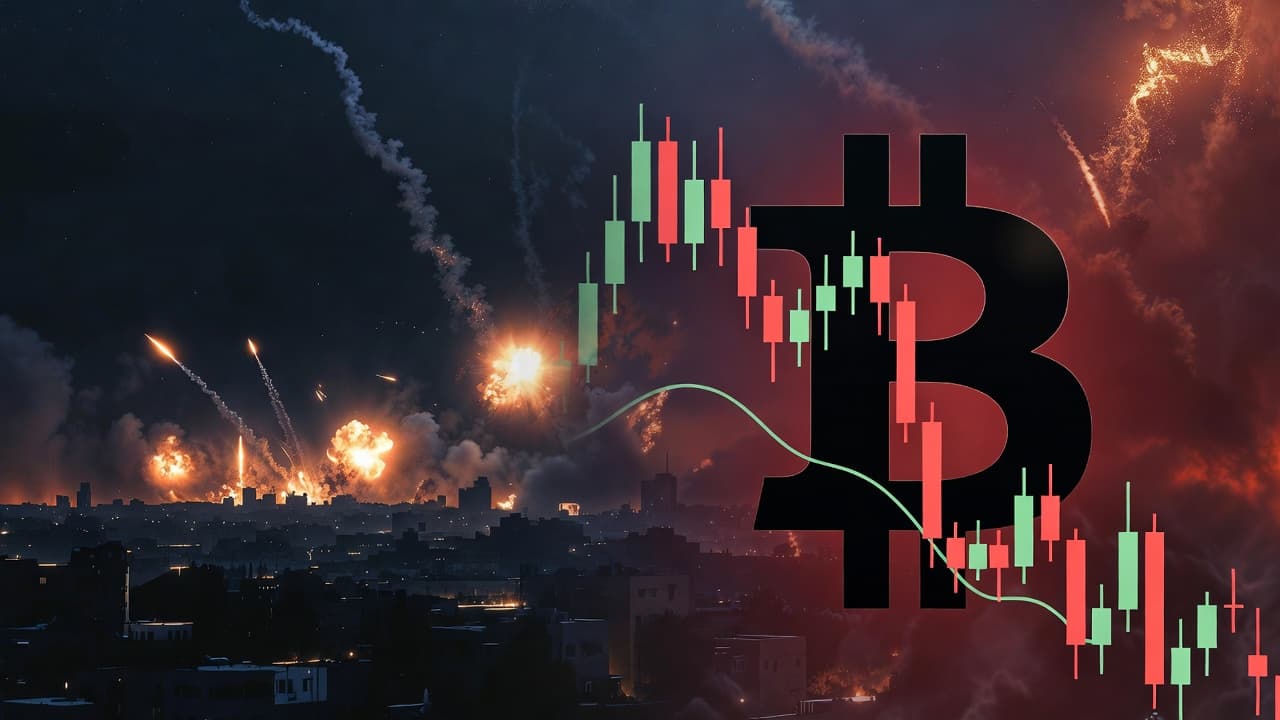
Iran's Supreme Leader Assassinated in US-Israeli Strikes: How It Shook — and Then Lifted — the Crypto Market
On February 28, 2026, a coordinated US-Israeli military operation killed Iran's Supreme Leader Khamenei. Crypto crashed 4% in minutes — then bounced. Here's the full breakdown of what happened and why.
On the morning of February 28, 2026, the world woke up to a seismic geopolitical event: a coordinated military operation by the United States and Israel against targets deep inside Iran — including the official residence and offices of Supreme Leader Ayatollah Ali Khamenei in central Tehran. Within hours, Israeli intelligence assessed that the 86-year-old leader — the longest-serving head of state in the Middle East — was dead.
The crypto market, the only major liquid market open on a Saturday, absorbed the full force of the shock. But what happened next defied the expectations of many. Here's a breakdown of the events, the market reaction, and the key forces that drove prices in both directions.
The Strike: Operation Epic Fury
U.S. President Donald Trump confirmed that the United States had begun "major combat operations" in Iran, citing missile threats and nuclear concerns. The joint offensive, dubbed "Operation Epic Fury," targeted Iran's military infrastructure, senior leadership, and nuclear facilities.
Israeli Defence Minister Israel Katz described the action as a "preemptive strike." Satellite imagery released shortly after revealed that Khamenei's Tehran compound had been reduced to rubble. Israeli officials confirmed that, in addition to the Supreme Leader, Iran's Defence Minister Amir Nasirzadeh and Revolutionary Guards Commander Mohammad Pakpour were among those killed.
Iran's Foreign Minister Abbas Araghchi initially insisted that Khamenei was still alive, telling NBC News: "As far as I know, yes, they are alive." However, the weight of evidence — including satellite imagery, Israeli intelligence assessments, and the absence of any verified public appearance — has since tilted the consensus firmly toward confirmation of his death.
The Immediate Crypto Crash
With traditional equity, bond, and commodity markets closed for the weekend, the cryptocurrency market became the sole pressure valve for global risk-off sentiment.
The impact was swift and brutal:
- Bitcoin (BTC) dropped nearly 4%, falling from approximately $65,500 to a local low of $63,038.
- Ethereum (ETH) slid 4.5%, dropping below $1,836.
- Altcoins including XRP (-8%), Solana (-11%), and Dogecoin (-10%) saw even steeper losses.
- Total crypto market cap shed roughly $128 billion in value within the first hour.
- Over $515 million in leveraged positions were liquidated within 24 hours, with $100 million wiped out in the first 15 minutes alone.
The selling was not random. Major exchanges — Binance, Bybit, Coinbase, Kraken, and Bitfinex — recorded nearly $5 billion in BTC outflows within 30 minutes, with institutional market makers like Wintermute and FalconX actively involved. Cascading liquidations of leveraged retail longs amplified the downturn.
Iran Retaliates: Missiles Fly Across the Gulf
Iran's response came swiftly and broadly. Tehran launched over 150 missiles targeting not only Israel but also U.S. military bases across the Gulf region:
- Bahrain — Juffair Naval Base
- Qatar — Al Udeid Air Base
- Kuwait — Ahmad al-Jaber Air Base and Camp Arifjan
- UAE — Al Dhafra Air Base and Al Fujairah Air Base, with one reported fatality
- Saudi Arabia — Prince Sultan Air Base in Riyadh
- Iraq — U.S. base in Erbil
The strikes on the UAE, Saudi Arabia, and other Gulf nations drew immediate condemnation. Saudi Arabia declared its readiness to support the United States "in any capacity" and expressed solidarity with all affected Gulf states. The regional alignment against Iran deepened significantly.
For the crypto market, this escalation initially reinforced the bearish narrative. Fears of a wider regional war — particularly any disruption to the Strait of Hormuz, through which roughly 20% of global oil flows — kept the Fear & Greed Index pinned at 14 (Extreme Fear).
The Bounce: Why Prices Started Rising
Despite the severity of the conflict, Bitcoin began recovering within hours, climbing from $63,000 back above $65,000 and eventually touching $66,000. This counterintuitive move can be attributed to several key factors:
1. Uncertainty Reduction
Markets don't simply react to "good" or "bad" news — they react to uncertainty. The initial crash was driven by the unknown: How far would this escalate? Would Iran deploy nuclear capabilities? Would oil supply be cut off entirely?
The reported elimination of Khamenei, along with top military commanders, paradoxically reduced uncertainty. A decapitated leadership structure means a potentially less coordinated Iranian response and a faster path to either regime collapse or negotiated de-escalation.
2. Leverage Flush and Technical Rebound
The $515 million in liquidations effectively purged overleveraged positions from the market. With that selling pressure removed, the order books were thinner on the sell side, allowing even modest buying to push prices higher. Short sellers who had profited from the crash also began closing positions (buying back), adding upward momentum.
3. Regime Change Narrative
Both Trump and Netanyahu explicitly called on the Iranian people to "take their fate into their own hands." Markets began pricing in a scenario where the conflict could end more quickly than a prolonged war, with internal Iranian upheaval replacing extended military escalation.
4. Dip-Buying Behavior
Historically, geopolitical shocks in crypto have followed a pattern of sharp initial sell-offs followed by recoveries. The April 2024 Iran-Israel missile exchange saw BTC drop to $61,000 before eventually reaching new all-time highs months later. Experienced traders recognize this pattern and move aggressively to buy dips at key support levels.
5. Weekend Liquidity Dynamics
Bitcoin's 24/7 trading makes it uniquely vulnerable to weekend geopolitical shocks, but it also means recovery can begin immediately — unlike equities, which must wait for Monday's open. Traders who sold in panic at $63,000 created a vacuum that buyers filled once the initial shock subsided.
Key Risk Factors Ahead
While the bounce offers some short-term relief, significant downside risks remain:
- Iran's full response is still unfolding. State media has promised a "crushing response," and missile strikes on U.S. bases are ongoing.
- Strait of Hormuz. Any attempt by Iran to disrupt oil flows through this critical chokepoint could trigger an energy price shock, reignite inflation fears, and drag all risk assets — including crypto — sharply lower.
- Monday's market open. Traditional markets (equities, bonds, commodities) have not yet had the chance to react. A broad risk-off move in global stocks could create a second wave of selling pressure on crypto.
- Institutional positioning. U.S. spot Bitcoin ETFs had already flipped to net sellers in February 2026, reversing last year's accumulation trend. This structural headwind predates the conflict.
- Options market signals. On Deribit, the $60,000 BTC put remains the largest put position by open interest, with significant positioning at $55,000 as well. The smart money is hedging for more downside.
Conclusion
The assassination of Ayatollah Ali Khamenei marks one of the most consequential geopolitical events in decades. For crypto markets, the day played out in two distinct acts: a violent crash driven by fear and forced liquidation, followed by a recovery driven by uncertainty reduction, leverage flushing, and dip-buying.
But make no mistake — the situation is far from resolved. With Iran retaliating across multiple countries, U.S. combat operations ongoing, and traditional markets yet to react, the coming 48 to 72 hours will be critical. The bounce may prove to be a genuine bottoming signal, or it may turn out to be a brief pause before the next leg down.
In times like these, risk management isn't optional — it's survival.
Stay ahead of the next move
Use Flicker to monitor your positions in real-time, set alerts on key price levels, and track portfolio PnL across exchanges — so you're never caught off guard.
Disclaimer: This article is for informational purposes only and does not constitute financial advice. Cryptocurrency investments carry significant risk, especially during periods of geopolitical instability. Always do your own research.
- Iran
- geopolitics
- bitcoin
- crypto crash
- market analysis
- BTC
- war
- Middle East
You might also like

Why Moderna (MRNA) Stock Surged 130% in a Single Day
Moderna had its biggest day ever on August 19, 2026, more than doubling after its Merck-partnered mRNA cancer vaccine won a Phase 3 melanoma trial. Here's what actually happened, why the move was this violent, and what still has to go right.

Free Bitcoin Trading Signals: Where to Find Them in 2026
Most Bitcoin signal providers charge $100+/month for recycled chart screenshots and vague calls. Here's where to actually get free, AI-powered BTC trading signals — and how to use them without getting burned.

Why Bitcoin Dropped from $126K to $77K — And What Comes Next
Bitcoin lost nearly 40% from its October 2025 all-time high. Here's a full breakdown of what happened, why it happened, and what traders should watch now.