

RSI Explained: How to Know If a Coin Is Overbought or Oversold
The Relative Strength Index (RSI) is one of the most used indicators in crypto. Learn how it works, how to read it, and how to avoid the mistakes most traders make with it.
If you've spent any time looking at crypto charts, you've probably seen people say things like "RSI is overbought" or "RSI just hit 30, time to buy."
But what does that actually mean? And more importantly — should you trust it?
RSI (Relative Strength Index) is one of the oldest and most widely used indicators in all of trading. It was created in 1978. Almost 50 years later, traders still use it every single day. There's a reason for that.
Here's everything you need to know about RSI — explained simply, with real crypto examples.
What Is RSI?
RSI stands for Relative Strength Index. It measures how fast and how much a coin's price has been moving — and whether that movement is likely to continue or reverse.
It shows as a number between 0 and 100:
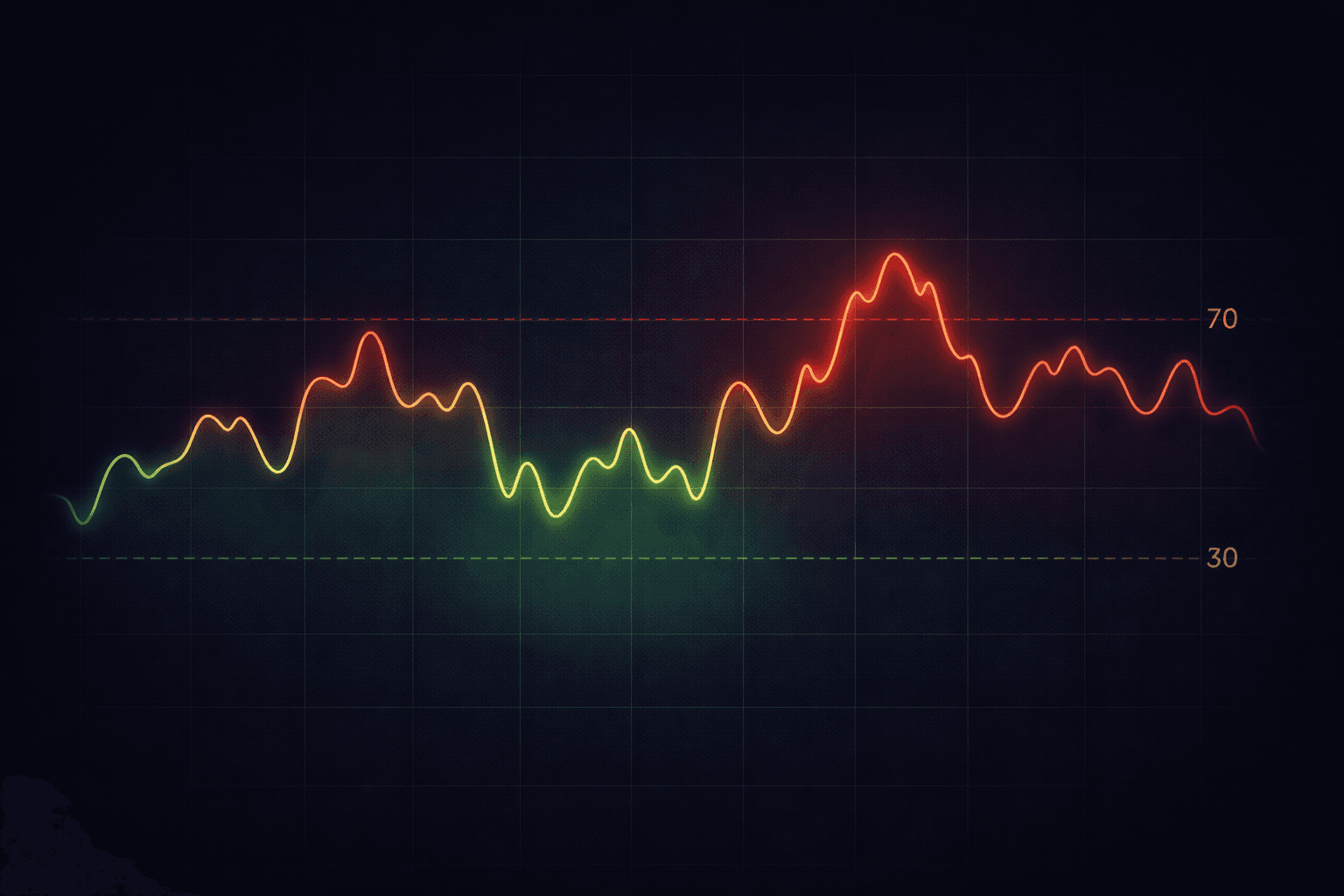
- Above 70: The coin is considered overbought — it's gone up a lot, fast
- Below 30: The coin is considered oversold — it's dropped a lot, fast
- Between 30 and 70: Neutral territory
That's it. At its core, RSI is answering one question: "Has this coin moved too far, too fast?"
When a coin goes up aggressively, RSI climbs toward 100. When it drops hard, RSI falls toward 0. Most of the time, it oscillates somewhere in between.
How RSI Is Calculated
You don't need to calculate RSI by hand — every charting tool does it for you. But understanding the logic helps you use it better.
RSI uses a simple idea: compare average gains vs average losses over a period (usually 14 candles).
The formula:
RSI = 100 - (100 ÷ (1 + RS))
Where RS = Average Gain ÷ Average Loss over the last 14 periods.
What this means in plain English:
- If a coin has been going up most of the last 14 days, RS is high, and RSI is close to 100
- If it's been going down most of the last 14 days, RS is low, and RSI is close to 0
- If gains and losses are roughly equal, RSI sits around 50
The 14-period default is what nearly everyone uses. Some traders use 7 (more sensitive, more signals, more noise) or 21 (smoother, fewer signals, less noise). Stick with 14 until you have a reason to change it.
What "Overbought" and "Oversold" Actually Mean
This is where most beginners go wrong.
Overbought (RSI > 70) does NOT mean "sell immediately."
It means the price has risen significantly in a short time. The momentum is strong. A pullback is more likely than usual — but it's not guaranteed.
In strong bull trends, RSI can stay above 70 for weeks. Bitcoin during major rallies routinely trades with RSI between 70 and 90 for extended periods. Selling the moment RSI hits 70 in a bull market means missing most of the move.
Oversold (RSI < 30) does NOT mean "buy immediately."
It means the price has dropped hard. A bounce is more likely — but in a real crash, RSI can stay below 30 for a long time too.
Think of it like a rubber band: the more it stretches, the more likely it is to snap back. But rubber bands can also break.
The key insight: RSI tells you about the intensity of a move. It doesn't tell you when the reversal will happen.
How to Actually Use RSI in Crypto Trading
1. Identify Potential Reversals
The classic use: look for overbought/oversold extremes.
- RSI drops below 30 → Start watching for buying opportunities
- RSI rises above 70 → Start watching for selling opportunities
But don't act on RSI alone. Wait for confirmation — a reversal candle, a bounce off support, or RSI crossing back above 30 (or below 70).
Better approach: Instead of using fixed 70/30 levels, adjust for market conditions:
- In a strong uptrend, use 80/40 instead of 70/30
- In a strong downtrend, use 60/20 instead of 70/30
This prevents getting faked out by a trending market.
2. Spot Divergences (RSI's Most Powerful Signal)
RSI divergence is when price moves one direction but RSI moves the other. This is one of the most reliable early warning signals in all of technical analysis.
Bearish divergence:
- Price makes a higher high
- RSI makes a lower high
- What it means: The rally is losing momentum even though price is still climbing. Smart money may be exiting.
Bullish divergence:
- Price makes a lower low
- RSI makes a higher low
- What it means: Selling pressure is weakening even though price is still falling. A bounce may be coming.
Divergences don't tell you when the reversal will happen — they tell you the current trend is weakening. Combine with support/resistance levels for better timing.
3. Confirm Trend Strength
RSI isn't just for reversals. It can confirm a trend is still healthy:
- In an uptrend, RSI typically stays between 40 and 80. If it dips to 40-50 and bounces, the trend is intact.
- In a downtrend, RSI typically stays between 20 and 60. If it rallies to 50-60 and gets rejected, the downtrend is intact.
If RSI breaks out of its typical range, the trend may be changing.
4. Time Your Entries in a Trend
Instead of buying blindly, use RSI to find better entries within an existing trend:
- Identify an uptrend you want to buy into
- Wait for RSI to pull back to 40-50 (a "reset")
- Enter when RSI starts climbing again
This helps you avoid buying at the top of a short-term move while staying aligned with the larger trend.
Real Crypto Examples
Bitcoin — November 2021 Top
In early November 2021, Bitcoin pushed to its all-time high near $69,000. RSI on the daily chart was above 70 — overbought.
But the real signal was bearish divergence: Bitcoin made a higher price high compared to October, but RSI made a lower high. Momentum was fading even as price climbed.
Within weeks, Bitcoin began a decline that would eventually take it to $16,000.
Bitcoin — November 2022 Bottom
After the FTX collapse in November 2022, Bitcoin crashed to around $15,500. RSI on the daily chart dropped to 18 — deeply oversold.
Then a bullish divergence appeared: price made a lower low, but RSI made a higher low. Selling pressure was exhausting itself.
Bitcoin bottomed and began a recovery that eventually led to new all-time highs.
Solana — Late 2023 Rally
When Solana started its rally from $20 to $100+ in late 2023, RSI broke above 70 and stayed there for weeks. If you had sold at RSI 70, you would have missed a 5x move.
This is why context matters. In a breakout, overbought RSI means strength, not weakness. You wait for RSI to eventually cool off and show divergence before considering an exit.
Common RSI Mistakes
1. Treating 70/30 as Automatic Buy/Sell Signals
RSI hitting 70 doesn't mean "sell now." RSI hitting 30 doesn't mean "buy now." These are zones of attention, not action. Always wait for confirmation.
2. Using RSI Alone
RSI measures momentum — nothing else. It doesn't know about support/resistance, volume, fundamentals, or market news. Combine it with other tools.
Pairs that work well with RSI:
- RSI + Support/Resistance: RSI oversold at a major support level is a much stronger signal than RSI oversold in the middle of nowhere
- RSI + Volume: An RSI divergence with declining volume is more meaningful
- RSI + MACD: RSI shows overbought/oversold, MACD shows momentum direction. Together they're more reliable
3. Ignoring the Timeframe
RSI on a 5-minute chart and RSI on a daily chart tell very different stories. A coin can be overbought on the hourly chart while still being neutral on the daily.
General rule:
- Daily RSI: Best for swing traders (holding days to weeks)
- 4-hour RSI: Good for short-term trades
- Weekly RSI: Best for long-term positioning
Higher timeframes give more reliable signals.
4. Fighting the Trend
RSI says "oversold" in a bear market. You buy. It drops more. RSI gets more oversold. You buy more. It drops more.
In strong trends, RSI can stay extreme for a long time. "Oversold can get more oversold." Always consider the broader trend before acting on RSI levels.
5. Not Looking for Divergences
Most traders only use RSI for overbought/oversold. They miss the most powerful feature — divergences. Divergence spotted price direction changes in Bitcoin with remarkable consistency at major turning points.
RSI vs Other Indicators
RSI vs MACD: RSI measures how overbought or oversold a coin is. MACD measures the direction and strength of momentum. They complement each other — use RSI to know if something is stretched, and MACD to confirm which direction momentum is heading.
RSI vs Bollinger Bands: Bollinger Bands show when price is at the edges of its typical range. RSI shows when momentum is extreme. Both can identify potential reversals, but they measure different things. An RSI divergence at a Bollinger Band extreme is a very strong signal.
RSI vs Stochastic: Both are oscillators that measure momentum. Stochastic is more sensitive and gives more signals — but also more false signals. RSI is smoother and more reliable, especially on higher timeframes. Most crypto traders prefer RSI for its simplicity.
How Flicker Shows You RSI Automatically
Here's the thing about RSI: it only works if you actually check it.
Most traders know about RSI in theory. But in practice, they don't check it across all their coins. They look at their favorite 2-3 tokens and ignore the rest. And they definitely don't check for divergences.
In Flicker, RSI is built into every coin's analysis:
- Automatic RSI readings for any coin you're tracking — no manual chart setup
- Signal integration — RSI levels are factored into Flicker's buy/sell signals alongside other indicators like MACD, Bollinger Bands, and support/resistance
- Real-time alerts — Get notified when coins enter overbought or oversold territory
- Multi-indicator view — See RSI in context with sentiment, smart money flow, and breakout probability
Instead of opening a charting tool, drawing lines, and checking RSI manually for each coin, Flicker surfaces RSI data as part of the bigger picture — so you know what matters without doing the work yourself.
See RSI + Signals for Every Coin
Free
Flicker shows you RSI, MACD, support/resistance, and buy/sell signals automatically — so you never miss a setup.


Summary
RSI is one of the most reliable tools in a crypto trader's toolkit — if you use it correctly:
- RSI measures momentum — how fast and how far price has moved
- Above 70 = overbought, below 30 = oversold — but these aren't automatic signals
- Divergences are RSI's most powerful feature — when price and RSI disagree, pay attention
- Context matters — RSI in a trend behaves differently than RSI in a range
- Combine with other tools — RSI works best alongside support/resistance, volume, and other indicators
- Higher timeframes are more reliable — daily RSI beats hourly RSI for most traders
Don't use RSI as a magic button. Use it as a lens that helps you see what's happening under the surface of price action. When a coin looks like it's pumping but RSI is silently diverging — that's the information edge that separates informed traders from the crowd.
Not financial advice
This article is for educational purposes only. RSI and other technical indicators are not guaranteed to predict price movements. Crypto trading is risky, and you can lose money. Always do your own research before making trading decisions.
FAQ
What is a good RSI for crypto?
There's no single "good" number. For buying opportunities, many traders look for RSI below 30 (oversold). For selling or taking profits, RSI above 70 (overbought) is a common warning sign. In trending markets, these levels shift — strong uptrends may use 80/40, while downtrends may use 60/20.
What RSI level means overbought?
An RSI above 70 is traditionally considered overbought. Above 80 is strongly overbought. However, in strong uptrends, RSI can stay above 70 for extended periods without a correction. Overbought doesn't mean "sell" — it means "pay closer attention."
What RSI level means oversold?
An RSI below 30 is traditionally considered oversold. Below 20 is deeply oversold. Like overbought, oversold can persist in strong downtrends. An oversold RSI at a major support level is a stronger signal than oversold RSI in open air.
Is RSI accurate for crypto?
RSI works well for crypto, especially on daily and weekly timeframes. Crypto's high volatility actually makes RSI more useful because extreme readings are more common and often precede reversals. The key is using RSI as one tool among several — not in isolation.
What is RSI divergence?
RSI divergence occurs when price moves in one direction but RSI moves in the opposite direction. Bearish divergence (price makes higher highs, RSI makes lower highs) warns of potential downturns. Bullish divergence (price makes lower lows, RSI makes higher lows) suggests selling pressure is fading. It's one of the most reliable early reversal signals.
Should I use RSI for day trading crypto?
You can, but be cautious. On shorter timeframes (5-minute, 15-minute), RSI generates many more signals — and many more false signals. If you day trade, consider using RSI on multiple timeframes (check the daily trend, then use the hourly for entries) to filter out noise.
- RSI
- technical analysis
- crypto trading
- overbought
- oversold
- trading indicators
- bitcoin
You might also like

MACD for Beginners: The One Indicator That Shows Momentum Shifts
MACD is the cleanest way to see when a coin's momentum is about to flip. Here's how it works, how to read the crossover, and how to combine it with RSI for stronger signals.

Altcoin Breakout Signals: How to Catch Momentum Before the Crowd
Funding rates, volume spikes, and technical indicators — the three signals that show up before an altcoin breaks out, not after. Here's how to read them together and catch momentum plays early.

Free Bitcoin Trading Signals: Where to Find Them in 2026
Most Bitcoin signal providers charge $100+/month for recycled chart screenshots and vague calls. Here's where to actually get free, AI-powered BTC trading signals — and how to use them without getting burned.