

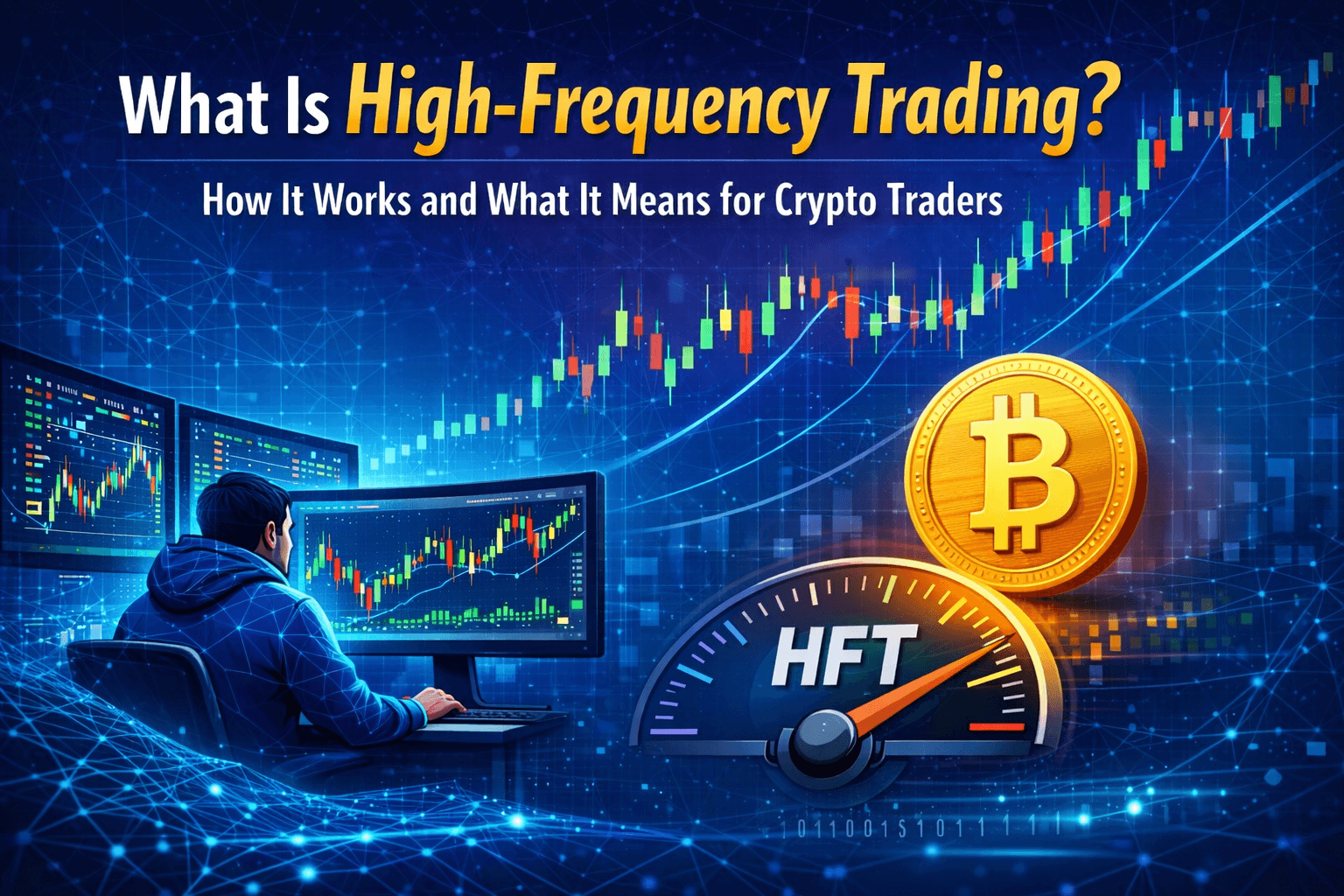
What Is High-Frequency Trading? How It Works and What It Means for Crypto Traders
High-frequency trading dominates traditional markets and is growing in crypto. Learn how HFT works, why it matters, and how retail traders can stay competitive.
You place a market order. By the time it fills, the price has already moved. Not by much — a fraction of a percent. But it happens every time.
That's not bad luck. That's high-frequency trading at work.
What Is High-Frequency Trading?
High-frequency trading (HFT) is a form of algorithmic trading that uses powerful computers to execute thousands — sometimes millions — of orders per second. These systems analyze market data, identify opportunities, and place trades faster than any human could blink.
HFT firms don't care about whether Bitcoin will hit $200K this year. They care about capturing tiny price differences that exist for milliseconds. Do that millions of times a day, and the profits add up.
How Does HFT Actually Work?
At its core, HFT relies on three things:
Speed
HFT firms spend millions on infrastructure — co-located servers next to exchange data centers, fiber optic cables, even microwave towers — all to shave microseconds off execution time. In HFT, being 1 millisecond faster than your competitor can mean the difference between profit and loss.
Algorithms
These aren't simple "buy low, sell high" scripts. HFT algorithms analyze order book depth, trade flow patterns, price correlations across exchanges, and dozens of other signals simultaneously. They adapt in real-time to changing market conditions.
Volume
Individual HFT trades make tiny profits — often fractions of a cent. The strategy works because of sheer volume. A firm might execute 100,000 trades in a single day, each making $0.01 in profit. That's $1,000/day from trades that last less than a second.
Common HFT Strategies
| Strategy | How It Works | Profit Source |
|---|---|---|
| Market Making | Continuously places buy and sell orders, profiting from the spread | Bid-ask spread |
| Arbitrage | Exploits price differences of the same asset across exchanges | Price discrepancies |
| Momentum Ignition | Places orders to trigger price movement, then trades the reaction | Short-term price moves |
| Latency Arbitrage | Trades on price updates before slower participants can react | Speed advantage |
HFT in Crypto Markets
Traditional stock markets have had HFT for decades. Crypto is catching up fast.
Here's why crypto is especially attractive for HFT firms:
- 24/7 markets — No closing bell. More trading hours means more opportunities.
- Fragmented liquidity — Hundreds of exchanges with different prices for the same asset. Arbitrage paradise.
- Less regulation — Fewer rules around order types and execution compared to traditional markets.
- Volatile spreads — During high volatility, bid-ask spreads widen, creating more profit opportunities for market makers.
Major crypto exchanges like Binance, Coinbase, and Kraken all have HFT activity. Some estimates suggest HFT accounts for a significant portion of total crypto trading volume.
Why This Matters for Retail Traders
If you're trading crypto manually — looking at charts, placing orders by hand — you're competing against systems that can:
- See and react to price changes in microseconds
- Analyze every order on the book simultaneously
- Execute trades before your order even reaches the exchange
This doesn't mean you can't be profitable. It means you need a different edge.
What Retail Traders Can't Do
- Compete on speed
- Profit from microsecond price differences
- Process millions of data points per second
What Retail Traders Can Do
- Think long-term — HFT firms don't hold positions for hours or days. That's your territory.
- Use structured setups — Entry zones, stop losses, and take profit levels give you a systematic approach that doesn't require millisecond execution.
- Follow smart money — Instead of competing with algorithms, watch what institutional players are doing and trade alongside them.
- Focus on risk management — HFT firms can afford to be wrong thousands of times. You can't. Every trade needs a clear invalidation point.
How Flicker Helps Retail Traders Compete
You don't need a $10 million server farm to trade crypto effectively. You need the right information at the right time.
Flicker gives you structured trade setups that level the playing field:
- Entry zones — Not a single price, but a range. You don't need split-second timing.
- Stop losses — Clear exit points so one bad trade doesn't wipe your account.
- Take profit levels — Multiple targets to lock in gains progressively.
- Smart money flow — See where institutional money is moving, so you're trading with the big players instead of against them.
- Breakout alerts — Get notified before breakouts happen, with probability scores and pattern analysis.
HFT firms win on speed. Retail traders win on strategy and patience.
Get Free Trading Signals
Free
Complete trade setups with entry zones, stop losses, and take profit levels. No subscription required.
 iOS
iOS Android
Frequently Asked Questions
Is high-frequency trading legal in crypto?
Yes. There are currently no regulations specifically prohibiting HFT in cryptocurrency markets. Traditional markets have some rules around HFT practices, but crypto largely operates in a less regulated environment.
Can I do high-frequency trading myself?
Technically, yes — but practically, no. HFT requires specialized hardware, co-located servers, custom-built algorithms, and significant capital. The infrastructure costs alone make it inaccessible for individual traders.
Does HFT make crypto markets more fair or less fair?
It depends on the strategy. Market makers who provide liquidity can reduce spreads and make trading cheaper for everyone. But latency arbitrage and momentum ignition strategies can disadvantage slower participants.
How do I know if HFT is affecting my trades?
If you consistently experience slippage on market orders — your fill price is slightly worse than what you saw on screen — HFT activity is likely part of the reason. Using limit orders instead of market orders can help reduce this impact.
Should I avoid trading during high HFT activity?
Not necessarily. Instead, adjust your strategy. Use limit orders, focus on longer timeframes, and rely on structured setups rather than trying to scalp small moves where algorithms have the advantage.
Not financial advice
This article is for educational purposes only. Flicker provides trading signals and tools, not financial advice. Always do your own research and never invest more than you can afford to lose.
You might also like
Best Crypto Exchanges to Start Trading in 2026 (With Free Sign-Up Bonuses)
Most 'best exchange' lists are useless because they ignore what actually matters when you're starting out: getting in fast, with a small budget, and ideally with someone else's money. Here's where to actually start — and how to grab a free bonus while you do.

MACD for Beginners: The One Indicator That Shows Momentum Shifts
MACD is the cleanest way to see when a coin's momentum is about to flip. Here's how it works, how to read the crossover, and how to combine it with RSI for stronger signals.

Top Crypto Signal Providers Ranked: Who's Actually Worth Following in 2026
Not all crypto signal providers are created equal. We ranked the top providers based on signal quality, transparency, pricing, and track record — so you don't have to lose money figuring it out.