


Guides
Free crypto analysis apps in 2026: what to check before you trust one
A free app for crypto trade ideas is only useful if it shows the exit. How to check a provider, what US traders should look at, and the red flags.
On this page
Most free crypto apps will tell you what to buy. Far fewer tell you where you'd get out.
An entry with no exit is half a plan. You don't know how much you're risking, and you don't know when the idea has stopped working. So before comparing apps, it helps to agree on what a trade idea needs, and how to check whoever is giving it to you.
Full disclosure: I built Flicker, one of the apps in this space. Below I describe what it does and where it stops, next to the other kinds of tools, so you can judge for yourself. To see a complete read while you go, open Should I buy Bitcoin?: the verdict, how the six factors voted, and, when there is one, the nearest zone with its stop and target.
What a useful trade idea includes
Whichever app or group it comes from, an idea you can act on has four parts:
- A stop. The level where you'd get out if the idea is wrong. Without it you can't size the position or know your loss.
- One or more targets. The levels where you'd take profit if it goes right.
- An entry range and a condition. A zone rather than a single price, and a rule for when to enter, such as a candle closing back above the zone.
- The reasoning. Why the idea exists, in terms you can check on the chart.
Two more things separate a usable app from a noisy one: prices are dated, so you know when the read was made, and the app is clear about what is free and what isn't.
Kinds of free crypto apps, by what you need
There is no single right app. There are tools built for different jobs, so here they are by use case.
You want a read before you buy: chart analysis apps
These read the chart and give you a view with levels. This is where Flicker sits.
What Flicker does:
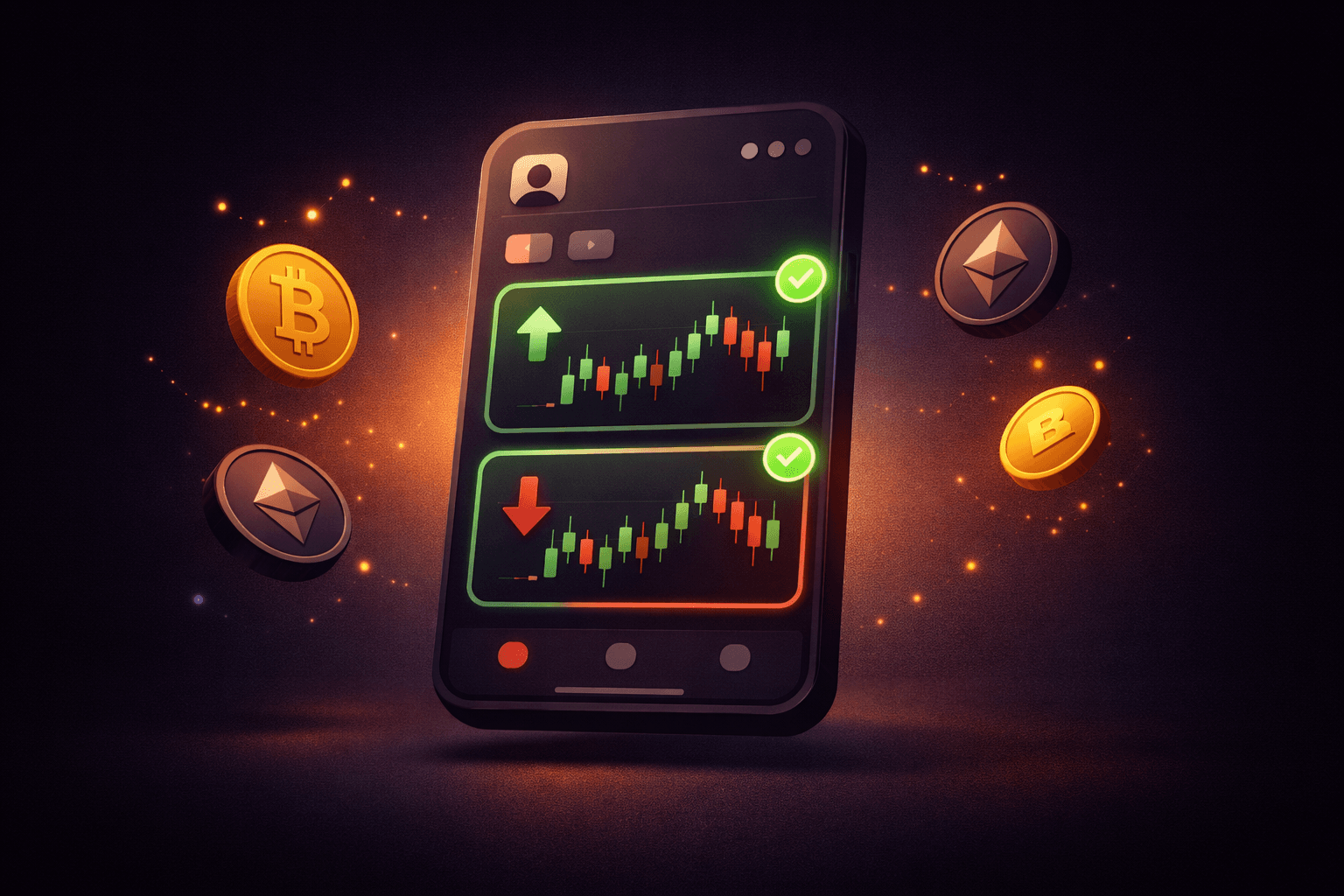
- Zones, each with its stop, up to two targets, an entry range, a risk/reward and a strength (strong, moderate or weak). The stop sits 1.5 × ATR(14) beyond the zone's edge, so it is sized to the normal swings of the timeframe you're reading.
- An entry rule for every zone: wait for a candle to close back above a buy zone's upper edge, or below a sell zone's lower edge.
- A verdict (buy, hold or sell) from six factors: trend direction, momentum, Fear & Greed, breakout setup, risk level and cycle phase. Confidence is how strongly they agree, for example 4 of 6, not a chance of profit. The verdict carries no prices; the exits belong to the zones.
- Alerts of ten types, including one when price enters a zone. Alerts need a free account.
- Coverage: coins, 50 stocks, and a list of currencies and metals that includes gold. DEX tokens open by contract address, and every DEX timeframe is free.
Where it stops:
- The free plan reads the daily timeframe, within set limits. Pro opens every other timeframe and the full chart history, and lifts the caps.
- It reads, marks and alerts. It never places a trade for you.
- There is no public record of its past reads, so judge it by what each read shows you.
Most of it needs no account: open Bitcoin analysis on the web, or use the iOS and Android app linked at the end of this post.
You want to scan many coins: screeners and analysis platforms
Screeners filter the market by indicators and chart patterns, and some add ready-made trade ideas. They suit someone who already knows what they're looking for. Free tiers usually limit the filters, the history or the number of ideas. Before relying on an idea, check that it carries a stop.
You want automation: bot platforms
Bot platforms connect to your exchange with API keys and place orders by rules you set, such as recurring buys, grids or trailing stops. They are about placing orders, not about analysis. Free tiers are usually small. Give a key only the permissions the bot needs; a bot that trades does not need permission to withdraw.
You want to follow someone: copy trading and marketplaces
Marketplaces let you follow other traders' ideas or copy their trades. The quality depends entirely on who you follow, and past results on a profile say nothing certain about the next trade. Apply the checks below to each trader, not only to the platform.
Telegram and Discord groups
Free signal groups are the most common starting point and the riskiest. Anyone can post, many ideas come without a stop, and some groups exist to sell you the coin they promote. If you use one, hold it to the same standard: a stop, a target, reasoning, and no pressure to act fast.
How to verify a provider before you trust it
Ratings are easy to fake in this industry. Many "top 10" lists rank by affiliate payout, and testimonials can come from accounts made last week. Five checks hold up better:
1. Do they publish losing trades?
Every real approach has them. A record with only wins has been curated. Ask for the full history, stopped-out trades included.
2. Was each idea published before the outcome?
A headline percentage in a graphic proves nothing. Look for ideas timestamped before the result was known, not a screenshot put together afterwards.
3. Does every idea include an exit?
If it doesn't say where the idea is wrong, it can't tell you how much you're risking.
4. Are the complaints specific?
Vague praise is easy to fake. Specific complaints, such as "the 15 Jan idea hit its stop and support took three days to answer", usually aren't. Compare app store reviews, Reddit and review sites; if they disagree sharply, be careful.
5. How do they make money?
Free has to be paid for somehow. Ads, a paid tier or partner fees are fine when they are stated. A free group that profits by moving the price of what it tells you to buy is not. Flicker's own model is a paid Pro plan and partner exchange offers, listed on promotions.
Red flags that end the conversation
- Promised returns. A provider who says you can't lose, or names a fixed monthly return, is claiming something no one can know. This is the clearest scam marker.
- A headline hit rate with nothing behind it. "Nine out of ten trades close in profit", with no published, timestamped history to check it against.
- Pressure to act fast. "Only five places left" or "this closes in ten minutes". A real setup doesn't run on a sales timer.
- No stop, ever. It isn't an oversight: without stops, the record can't be checked.
- Small coins with no word on liquidity. When a thinly traded coin is promoted to thousands of people at once, the early buyers need someone to sell to. That someone is you.
- Claims that money multiplies. "Double your account every month." If it worked, it wouldn't be for sale.
US traders: what to check first
Most global lists skip a problem that rules out many options for Americans.
- Can you trade the pair? Many large groups are built around exchanges or products that don't serve US customers. Check the pair is listed on a venue you can use before you subscribe. A read made of price levels, like Flicker's, can be followed on any venue that lists the pair; small price differences between venues are normal.
- Time zones. A group run from Europe or Asia may post at 3 AM Eastern. An alert that fires when price reaches a level means you don't have to be awake for it.
- Does the provider accept US customers? Some quietly exclude them, sometimes after you've paid. Read the terms first, and if they don't say, ask.
- Payment. Start with the shortest plan available, in case billing doesn't work with your card.
Free or paid: is paying worth it?
Price and quality aren't linked. A paid group can have every problem a free one has, and a monthly fee takes a large share of a small account.
Paying can make sense when:
- you want mentoring from someone whose record you can check,
- you need a niche the free tools don't cover,
- the provider has a long, timestamped record that includes losses.
Test the free tier first. If ideas with a stop and a target aren't working for you, a paid feed of the same thing usually won't either.
With Flicker you can start free with the daily read. Pro opens every other timeframe and the full chart history, and lifts the free plan's caps. Opening an exchange account through a partner promotion adds 30 days of Pro, and each partner adds another 30.
How to use any app's trade ideas
1. Read the stop first. Decide whether you could accept a loss down to it before you look at the target.
2. Size the position to the stop. Being stopped out should cost an amount you can live with. With leverage, the futures position calculator shows whether liquidation would come before the stop.
3. Wait for the entry condition. Price touching a zone is not an entry.
4. Plan the targets. Decide in advance how much you'd take at each one. The P&L calculator works out what each target is worth.
5. Keep a record. Write down every idea you took, with its stop, its target and the result. After a few dozen you'll know whether a source works for you.
FAQ
Is there a good free app for crypto trade ideas?
There are several kinds, depending on the job: chart analysis apps, screeners, bot platforms and copy trading. Whichever you pick, check that each idea carries a stop and a target, and that the app says plainly what is free. Flicker's daily read, with its verdict, zones, stops and targets, is free and needs no account.
Can you trust a free crypto analysis app?
Whether it's free says little. What matters is whether every idea has an exit, whether the reasoning is visible, and whether any record it shows includes losses and was published before the outcome.
Is there a crypto analysis app without a subscription?
Yes. Flicker's free plan doesn't expire and needs no card; it covers the daily timeframe within set limits. Pro is optional and opens every other timeframe.
What should a crypto trade idea include?
A stop, at least one target, an entry range with a condition for entering, and the reasoning. If any of these is missing, you fill the gap with a guess.
Which apps work for US traders?
Any that give price levels you can follow on a venue available in the US. Check that the provider accepts US customers before paying, and be careful with groups built around exchanges that don't serve the US.
How do I start as a complete beginner?
Pick one source that shows its reasoning. Follow its ideas on paper first: write down the entry, the stop, the target and what happened, with no money at risk. Once you can tell a clear setup from a weak one, start small and always set the stop. Following many sources at once mostly gives you contradictions.
How much money do I need to start?
Less than most people think, and starting small is sensible. Fees and spreads take a bigger share of small positions, so trade less often rather than more. Use an amount whose total loss wouldn't change your life, and add to it only once your record shows the process works.
Are paid signal groups better than free ones?
Not by default. Look for complete ideas, a timestamped record that includes losses, and pairs you can actually trade. Try the free tier first.
Whatever you use, look for the exit before the entry. To see what that looks like on a real chart, open Should I buy Bitcoin?.
Get Flicker
A verdict, its reasons, and each zone's stop and targets, for coins, stocks and currencies. Start free.

We analyze. You decide. We never trade for you.
Analysis, not advice. Prices move; you can lose money.
- crypto analysis
- free crypto app
- crypto trade ideas
- stop loss
- take profit
- crypto scams
- crypto in the US
- crypto for beginners
You might also like
Guides7 min read
Ethereum analysis 2026: reading its buy zone, stop and targets
What Flicker's Ethereum read shows before you buy: the verdict and how many of six factors agree, each zone's stop and targets, and when to enter.
Guides6 min read
Hyperliquid analysis 2026: reading its buy zone, stop and targets
What Flicker's Hyperliquid read shows before you buy: the verdict and how many of six factors agree, each zone's stop and targets, and when to enter.
Guides6 min read
XRP analysis 2026: reading its buy zone, stop and targets
What Flicker's XRP read shows before you buy: the verdict and how many of six factors agree, each zone's stop and targets, and when to enter.