



News
Binance Hack: Up to $5.8B Drained From Hot Wallets — What We Know
On 29 October 2026 billions left Binance hot wallets in about 40 minutes. What is confirmed, what is still an estimate, how the drain worked, and what it means for users and BNB.
On this page
On 29 October 2026, between $3.3 billion and $5.8 billion left Binance hot wallets in about 40 minutes, depending on who is counting. If it is confirmed as a hack, it is the largest crypto theft on record, two to four times the $1.5 billion taken from Bybit in February 2025.
Binance has not confirmed a breach. It says it is investigating and that user funds are safe. Its founder, Changpeng Zhao, says it "does look like a hack."
This post separates what is confirmed from what is still an on-chain estimate. Everything here is as of 30 October 2026; figures will move as Binance publishes its findings. If you hold BNB, the BNB read shows the levels where you'd get out, dated to the last close.
What happened, minute by minute
All times are UTC, 29 October 2026, from on-chain data reported by Decrypt.
| Time | Event |
|---|---|
| Earlier that day | An address funded through Tornado Cash, a mixer, deploys a new contract |
| ~20:20 | The same address submits an EIP-7702 delegation for a Binance hot wallet, pointing it at that contract |
| 20:24 | First transfer: 167,464 ETH plus 63 token transfers, including 1.615 billion USDT, go to a brand-new address |
| After 20:24 | Further outflows on Ethereum, Bitcoin and Tron |
| 21:04 | Circle freezes 823 million USDC in the main receiving wallet |
The delegation landed about three and a half minutes before the first transfer.
How much was taken
No figure is confirmed. Four counts are circulating, and they measure different things:
| Source | Amount | What it counts |
|---|---|---|
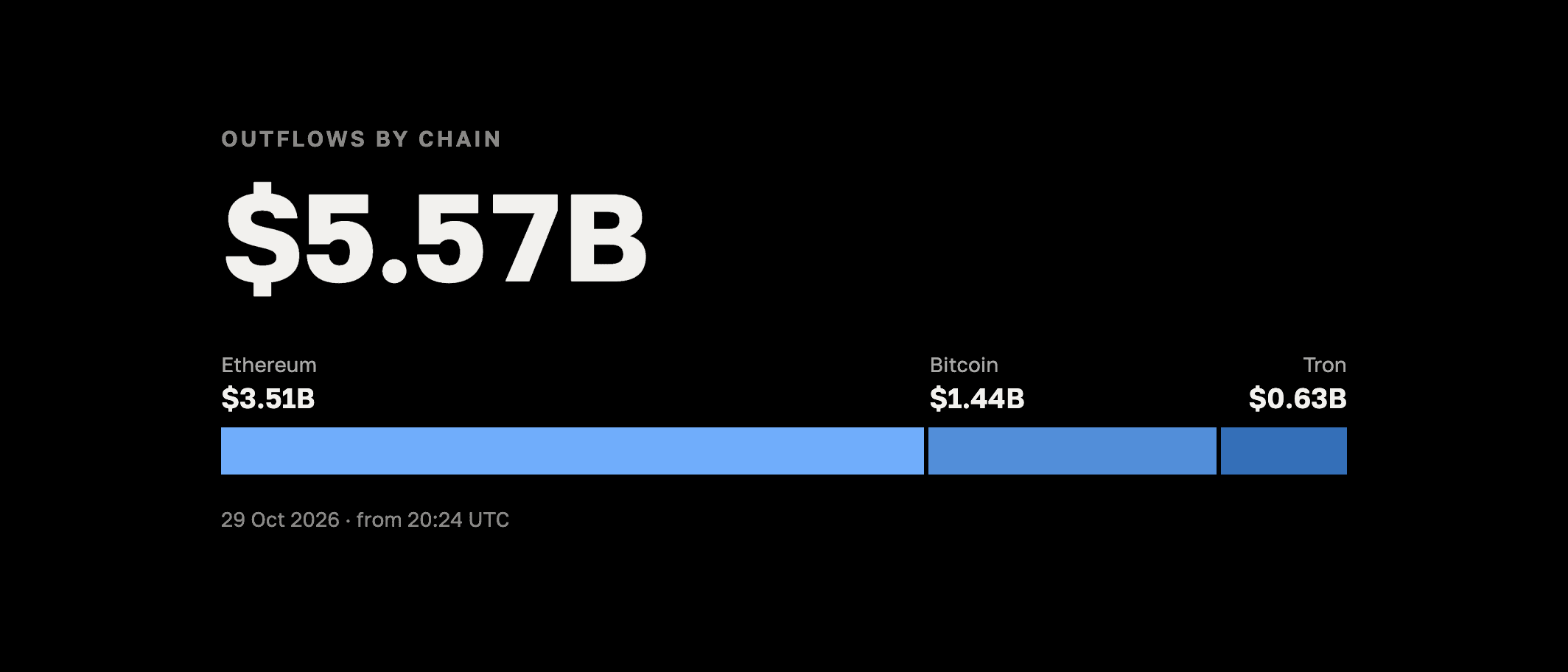
| Decrypt's on-chain tally | at least $5.57B | Ethereum, Bitcoin and Tron outflows combined |
| Conor Grogan (Coinbase) | up to $5.8B | His own estimate of total outflows |
| Spreek (on-chain analyst) | about $3.55B | Transfers into one unlabeled receiving wallet |
| Blockaid | about $3.3B | Suspicious hot-wallet outflows on Ethereum, Arbitrum and Avalanche |
Decrypt's tally breaks down by chain:
| Chain | Outflow |
|---|---|
| Ethereum | $3.51B |
| Bitcoin | $1.44B (18,270 BTC) |
| Tron | $0.63B |
| Total | $5.58B |
Rounded by chain, the parts add to $5.58 billion; Decrypt reports the unrounded total as $5.57 billion. The Bitcoin figure values 18,270 BTC at about $78,800 each, the price on the evening of 29 October.
The tokens named in reports include ETH, BTC, USDT, USDC, BNB and more than 60 other tokens.
How the drain worked: EIP-7702
EIP-7702 is an Ethereum upgrade that lets an ordinary wallet hand control to an on-chain program (a contract). Once a wallet signs a delegation, the contract's code can move that wallet's funds without asking for another signature.
That is the mechanism reported here. Odysseas Lamtzidi of Phylax Systems put it this way: "The delegation persists; that code can authorize later transfers without another signature from the wallet."
The open question is the signature. A delegation has to be signed with the wallet's own key. Nobody outside Binance knows yet how the attacker got that signature: a stolen key, a compromised signing system, or a signer tricked into approving it.
Not the first warning
A study presented at USENIX Security 2026 found attacker-linked contracts in 63% of early EIP-7702 authorization transactions, well before this incident.
What has been frozen
Stablecoins can be frozen by their issuers, and that is where most of the recovery so far comes from. About $1.8 billion was frozen within hours.
| Issuer | Frozen | Source |
|---|---|---|
| Tether | 975.1M USDT in the main receiving wallet; Tether's CEO later said more than 1.567B USDT in total | On-chain data; Paolo Ardoino on X |
| Circle | 823M USDC, at 21:04 UTC | On-chain data; Jeremy Allaire on X |
Circle's CEO Jeremy Allaire said the freeze was done "in coordination with law enforcement."
On-chain data also shows Aave froze lending markets to stop the attacker from borrowing against stolen assets. Aave has not issued a statement.
ETH, BTC and most other tokens cannot be frozen this way. That part of the outflow is out of reach unless it passes through an exchange or service that blocks it.
What Binance has said
Binance has not confirmed a hack. Its statements so far:
- On X, at 21:16 UTC: "At this stage, we have not confirmed any impact to user funds." Binance edited the post twice; by 21:29 UTC it read: "User funds are completely safe."
- Co-founder Yi He: "We are aware of reports regarding a potential security issue and are actively investigating the matter." She added that updates will come only through official Binance channels, and warned users not to trust unofficial links, messages or requests for account information.
- Binance also repeated its line that user funds are "SAFU", its emergency insurance fund.
Changpeng Zhao, who no longer runs the exchange, wrote that the outflow "does look like a hack on Binance," and: "as a shareholder, I expect all user funds will be fully covered." That is his expectation, not a Binance commitment.
At the time of writing, no reports we found describe a suspension of withdrawals, and Binance has not said whether it will draw on the SAFU fund.
Market reaction
Prices as of the evening of 29 October, from Decrypt's market snapshot:
Bitcoin and ETH fell 2% to 4% within an hour of the first reports. BNB fell hardest because it is Binance's own token. Monero rose; Decrypt notes it also jumped after a $333 million Bitcoin theft in April 2025.
Binance's past incidents
| Date | Incident | Size |
|---|---|---|
| May 2019 | Hot wallet hack | 7,000 BTC, about $40M then; covered by the SAFU fund |
| October 2022 | BNB Chain cross-chain bridge exploit | about 2M BNB minted, roughly $570M then |
| October 2026 | Hot wallet drain (suspected) | $3.3B – $5.8B, unconfirmed |
In 2019 Binance paused withdrawals for about a week and covered the loss in full from SAFU. Whether it can do the same at many times the size is the question the market is pricing.
What to check if you use Binance
These are choices, not instructions. What fits depends on what you hold and where.
Watch for phishing first. The most likely way to lose money this week is not the hack itself but a fake "Binance security" message asking you to log in, verify, or move funds. Binance says it will only post updates through its official channels.
Know where your coins sit. Funds on an exchange are a claim on that exchange. Funds in a wallet you control are not affected by an exchange's hot wallets. Moving coins has its own risks and fees; it is a trade-off, not a fix.
If you hold BNB, decide your exit before the next headline. News like this moves fast in both directions: a confirmed full cover could lift BNB; a confirmed loss with no cover could push it lower. Deciding the level where you'd get out, before the next update lands, keeps the decision yours instead of the market's.
If you trade with leverage, check your liquidation price. A 7% move in an hour is enough to close many leveraged positions. The liquidation calculator shows where yours sits.
Check BNB before you act
A verdict on BNB, its reasons, and each zone's stop and targets, dated to the last close. Start free.


FAQ
Was Binance hacked?
Not confirmed. On 29 October 2026, between $3.3 billion and $5.8 billion left Binance hot wallets in a pattern on-chain analysts describe as a hack, and Changpeng Zhao said it "does look like a hack." Binance says it is investigating and has not confirmed any impact to user funds.
How much was stolen from Binance?
Estimates range from about $3.3 billion (Blockaid) to $5.8 billion (Conor Grogan). Decrypt's on-chain tally is at least $5.57 billion across Ethereum, Bitcoin and Tron. About $1.8 billion in USDT and USDC has been frozen.
Are my funds on Binance safe?
Binance says user funds are safe and that it has not confirmed any impact to them. Changpeng Zhao said he expects all user funds to be fully covered. Neither has published a loss figure or a cover plan yet.
How did the Binance hack happen?
Reports describe an EIP-7702 delegation: a Binance hot wallet was pointed at an attacker's contract, which then moved funds without further signatures. The delegation had to be signed with the wallet's key; how the attacker obtained that signature is not known.
Is it the biggest crypto hack ever?
If confirmed, yes. The previous record was the roughly $1.5 billion taken from Bybit in February 2025.
What happened to the BNB price?
BNB fell about 7% to roughly $699 on the evening of 29 October 2026.
Sources
- Decrypt: Binance drained of $5.5 billion in suspected hack
- The Block: Binance investigating hack as suspicious outflows reach up to $5.8 billion
- FinanceFeeds: Suspected Binance hack drains $3.3B from hot wallets
- FinanceFeeds: Binance hack statement edited twice to say funds are safe
- Crypto Briefing: Binance founder says user funds appear safe
Analysis, not advice. Prices move; you can lose money.
- binance hack
- binance
- BNB
- crypto hack
- EIP-7702
- exchange security
You might also like
News5 min read
X Bans InfoFi Apps: KAITO Drops 20% After API Crackdown
Elon Musk's X revokes API access for crypto 'InfoFi' apps citing AI spam. KAITO token plummets as the attention economy faces its first major platform ban.

Guides4 min read
How to Earn Interest on Your Euros in 2026 (Without Locking Them Up)
Most current accounts pay close to nothing on euros. Here is how euro savings on open money markets work, what Rebind offers on top, and the risks to read before you move money.

Guides8 min read
How to get free crypto in 2026: what actually pays
Every real way to get free crypto in 2026, with honest numbers: sign-up bonuses, learn-and-earn, airdrops, faucets, and the offers that never pay.